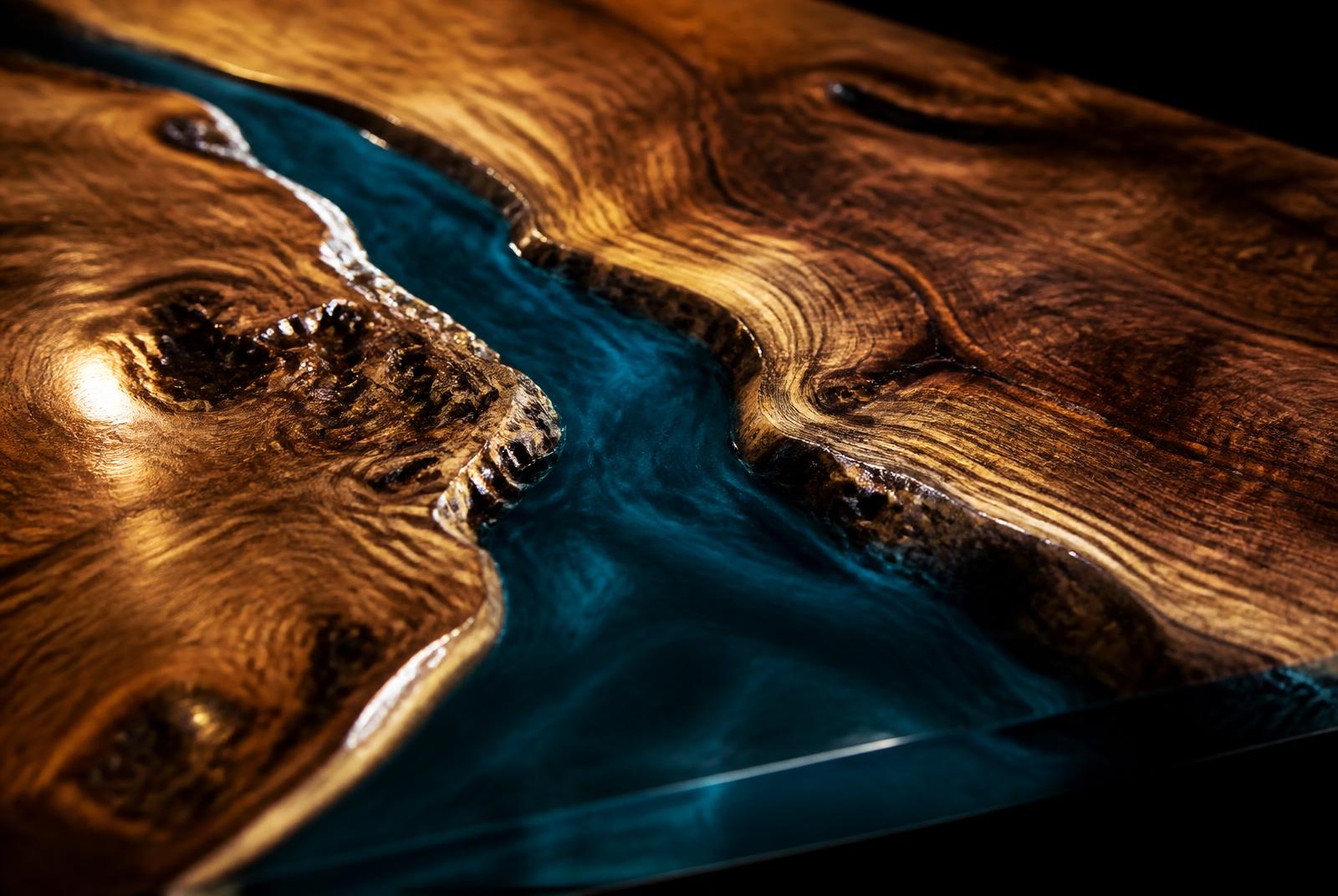
Wood does not stop moving when it leaves the workshop. It takes up and gives off moisture with the air around it for the rest of its life, and South Africa asks more of that relationship than most climates: a Johannesburg winter can sit below 25% relative humidity while a Durban summer holds above 80%. Everything below is about managing that one variable, plus sunlight, heat and the occasional beetle.
Know your climate
Highveld — Gauteng, Free State, Mpumalanga escarpment
Very dry winters (often 20–30% relative humidity) and wet, warm summers.
What goes wrong: Boards shrink hard in July and swell again in December. Panels split, joints open, epoxy rivers show a hairline shadow at the timber edge.
What to do: Keep the room between 40% and 55% humidity. A cheap hygrometer and a bowl of water near the heater in winter does more than any polish. Never place a piece within 1.5 m of a fireplace, gas heater or underfloor heating vent.
Coastal — KwaZulu-Natal, Eastern & Western Cape seaboard
High humidity, salt-laden air, and long damp spells.
What goes wrong: Timber takes up moisture and swells, drawers stick, steel bases and fixings corrode, and mould can bloom on oiled surfaces in a closed holiday home.
What to do: Ventilate. Wipe steel legs and fixings monthly with a barely oiled cloth. In a house that stands empty, leave interior doors open and use a small dehumidifier or moisture absorber rather than sealing the room.
Karoo, Northern Cape and Limpopo lowveld
Extreme diurnal swings and fierce sun.
What goes wrong: One face of a slab dries faster than the other and the top cups. Direct sun bleaches Kiaat and darkens Imbuia unevenly.
What to do: Rotate the piece or the placemats seasonally so light falls evenly. Close blinds during the hottest four hours. UV-filter film on a north-facing window is the single best investment for a table in a sunroom.
The routine
Every week
- Dust with a dry or barely damp microfibre cloth, following the grain.
- Lift, never drag, anything placed on the surface — grit under a vase is what scratches, not the vase.
- Wipe spills immediately. Water, wine, citrus and vinegar are the four that mark fastest.
Every month
- Clean with a cloth wrung out in warm water and a drop of pH-neutral soap; dry straight after.
- Check that felt pads under chairs and bases are intact.
- Inspect steel or brass details for early corrosion, especially at the coast.
Every three to six months
- Re-oil an oiled or hardwax-oil surface: thin coat, work it in, wipe off all excess after 15 minutes.
- Check joints and knock-down fixings — a quarter turn now prevents a repair later.
- Look underneath. Cupping, damp marks and borer dust always show on the unfinished face first.
Once a year
- Full clean, light de-nib with 320-grit or a white pad, then a maintenance coat.
- Photograph the piece. It makes insurance and any future restoration far simpler.
- Book a workshop service if the piece lives in a restaurant, lodge or high-traffic reception.
Care by finish
Hardwax oil (our default)
- Feel:
- Matt, natural, you feel the timber.
- Care:
- Warm water and neutral soap. Re-oil every 3–6 months in a home, every 6–8 weeks in hospitality.
- Repair:
- Spot-repairable. A ring mark or scratch sands out locally and blends without stripping the whole top.
Penetrating tung / danish oil
- Feel:
- Deep, slightly richer colour, low sheen.
- Care:
- Same as above but thirstier — expect more frequent coats in the first year.
- Repair:
- Very forgiving; the easiest finish to maintain yourself.
Two-pack polyurethane / lacquer
- Feel:
- Sealed film, satin to gloss, best for bars and commercial tops.
- Care:
- Damp cloth only. Do not oil it — oil sits on top and goes tacky.
- Repair:
- Not spot-repairable. Damage means a full re-spray of that surface.
Epoxy resin surfaces
- Feel:
- Glass-like, part of the top rather than a coating.
- Care:
- Neutral soap and water. No acetone, no methylated spirits, no abrasive cream.
- Repair:
- Fine scratches polish out with automotive plastic polish. Deep damage is a workshop job.
What never to use
- Silicone-based spray polish (Pledge and similar) — it builds a film that repels future oil and makes refinishing expensive.
- Bleach, ammonia, methylated spirits, Handy Andy or any all-purpose cleaner on oiled timber.
- Hot pots, kettles and braai grids straight onto the surface. Use a trivet — heat marks the finish and can craze resin.
- Plastic or rubber mats left in place. They trap moisture and can print permanently into an oiled top.
- Leaving a wet cloth, dish rack or potted plant standing on timber. Ten minutes is fine; overnight is a black mark.
Fixing what has already gone wrong
- White ring or cloudy haze
- Moisture trapped in the finish, not in the wood. On an oiled top, rub gently along the grain with a cloth and a little of the same oil; on lacquer, a hairdryer at low heat held 200 mm away usually lifts it.
- The top has cupped
- Almost always uneven moisture — one face sealed, the other not, or a damp floor. Move the piece off the damp source, and if it does not relax within a few weeks, send it back for re-flattening.
- A hairline gap along the resin river
- Seasonal movement of the timber against a stable resin. Normal on the Highveld in August. It typically closes again in summer. Persistent gaps are a warranty matter — call us.
- Fine powder and pinholes appearing
- Powderpost or common furniture borer. Act immediately: isolate the piece, treat with a borer fluid, and contact us. All Design4Me and UWD timber is kiln-dried, which kills larvae, but reclaimed or client-supplied stock can arrive infested.
- Scratches in daily-use tops
- On oil, sand locally with 240 then 320-grit along the grain and re-oil. On lacquer or resin, polish rather than sand, and speak to us before using anything abrasive.
Moving, storing and lending a piece
Carry tables on their edge, never flat on the top, and never by the overhang of a slab. Remove the base before transport where the design allows it. In storage, keep the piece off a concrete floor on battens, wrapped in moving blankets rather than plastic — plastic traps moisture against the timber and is the most common cause of mould and staining we see on returned pieces. Never store a slab flat on a garage floor in a Gauteng winter.
We service every piece we build
Refinishing, re-flattening, re-oiling and repair are done in our own Krugersdorp workshop, on hospitality contracts as a scheduled programme and on private pieces on request. If something is not behaving, send us a photograph before you attempt a fix — most damage is far cheaper to correct early.